Professional TV Mounting in Boise, Meridian, and Nampa
Professional TV mounting can cost from $200 to $350 for basic setups and take between 45 and 90 minutes. That said, true prices and times will vary based on your needs and any add-ons.
Your appointment will involve a site assessment, precise mount installation, and basic management of cables. During the installation process, a professional will also ensure that the necessary device cables have adequate access to power and protection from bending or fraying. Professional installation can help make your TV level and secure, minimizing any damage to the corresponding wall.
Professional TV Mounting in Boise, Meridian, and Nampa
Let Us Call You
Thank you for contacting us!
A representative from our office will get back to you shortly to schedule service.
We're Sorry
Due to a system error, we did not get your request. Please call us for immediate assistance.
We're Sorry
We don't currently provide service to this ZIP/Postal code.
Yes! You can email me service reminders and other messages.
Mr. Handyman, a Neighbourly company, on its own behalf and on behalf of its affiliates and franchisees requests your consent to send promotional and other electronic messages to you concerning products and services they believe are of interest to you. By checking this box, you agree to receive these messages. You can unsubscribe at any time.
Text opt-in does not apply for Canadian residents.
How Much Does TV Mounting Cost?
Professional TV mounting in the Boise, Meridian, and Nampa area can cost from $200 to $350 for basic installations on drywall. Costs may change depending on certain factors, including:
Pre-bought mount.
Installation on masonry or tile.
Installations above fireplaces that need to account for chimneys or gas lines.
Heavier TVs that require more bracing.
Device add-ons, like soundbars and gaming consoles.
In-wall wire concealment where applicable.
All of these factors are discussed and priced during the initial service consultation, as well as price and financing agreements. Once you’ve agreed on a price and payment method, the work will begin.
What's Included in a TV Mounting Appointment
When the service technician arrives at your home for your installation appointment, you can expect them to do the following:
Confirm placement and viewing height.
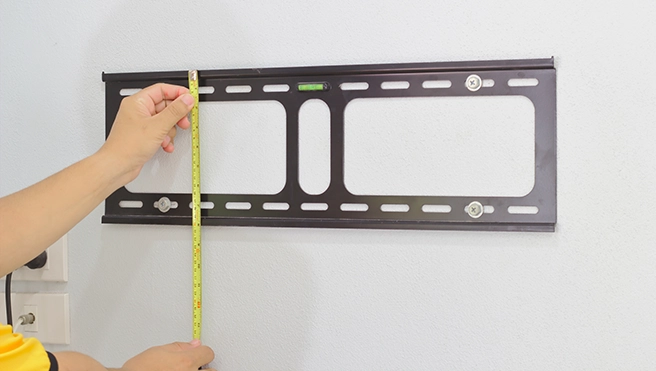
Locate studs or install masonry anchors.
Install the mount.
Hang and level the TV.
Manage cables and any add-on devices.
Test for function.
Clean up.
Your standard TV installation appointment can be anywhere from 45 to 90 minutes. However, appointments may be longer depending on the add-ons selected at the service consultation.
Types of TV Mounts
Compare TV mounts
Which TV mount fits your room?
Each mount trades wall clearance for movement. The more a mount moves, the stronger its wall anchoring needs to be.
Fixed
Sits closest to the wall with no movement.
MovementNone
Best forSeating that faces the TV straight on
AnchoringStandard
Tilting
Angles the screen down toward your seating.
MovementTilts down
Best forTVs mounted above eye level
AnchoringStandard
Full-motion
An arm extends and swivels for the most range of motion.
MovementExtends and swivels
Best forCorner placements and open floor plans
AnchoringStronger (the arm adds leverage)
Fireplace pick
Pull-down
Lowers the TV from a high position to eye level.
MovementLowers to eye level
Best forAbove a fireplace
AnchoringSolid structural support; tends to cost more
Supplying your own mount? It needs to match your TV’s VESA hole pattern and weight rating. Your technician will check it before installing, since an incompatible mount is one of the most common reasons an install fails.
You can provide your own mount for installation or request that we provide one. Providing your own mount may save you money on installation costs; however, you’ll want to ensure that your mount meets all the necessary requirements for your TV and wall, which will require some research. Resources from the Video Electronics Standards Association (VESA) outline best practices that your technician may follow. This includes adhering to the appropriate VESA mounting pattern (or the layout of screw holes on the back of your device) and the weight rating of your TV to ensure it’s mounted correctly.
Common mounting options for your TV include fixed, tilting, full-motion, and pull-down mounts. Your technician can help advise which is best for your desired setup.
Fixed, Tilting and Full-Motion Mounts
Whether you want a fixed, tilting, or full-motion mount largely depends on personal preference and room setup.
Fixed: These mounts sit closest to the wall with no movement. They are best when your seating faces the TV straight on.
Tilting: These mounts have the ability to angle the screen down, which is useful when the TV sits higher than eye level. You may have seen these mounts in office spaces or waiting rooms.
Full-motion: These mounts have an arm that extends and swivels. These mounts offer the most range of motion and can be optimal for corner placements and open floor plans. These mounts require stronger anchoring than fixed or tilting mounts, since the arm adds leverage and increases the force put on the anchors.
Your service technician can help advise on which mount may work best for your preference during your initial site consultation if you don’t have a strong preference.
Pull-Down Mounts
Pull-down mounts lower the TV to eye level from a high position, most often above a fireplace. These mounts tend to cost more, as they need solid structural support similar to full-motion mounts, and are typically most used above fireplaces, which have specialized installation needs to account for excess heat output and potential in-wall ventilation.
Mounting on Brick, Stone, Plaster and Other Walls
Mounting by wall type
What’s behind your TV changes the job
Your wall type determines the anchors, tools, and mounting method, along with your price and appointment length.
TV mounting complexity and requirements by wall type
Wall type
Complexity
What your technician does
Drywall with studs
Simplest
Locates the studs and mounts directly to them. The easiest and quickest installation.
Brick or stoneIncluding stacked-stone fireplaces
More complex
Uses masonry anchors and a different drilling method, placing anchor points in solid material rather than mortar joints where possible.
Faux-stone surroundCommon in newer Meridian, Eagle, and Star homes
More complex
Checks the surround before mounting to confirm it can hold the weight, then uses the right anchors and tools.
Plaster and lathCommon in older Boise North End and East End homes
Most complex
Works carefully around a delicate wall, with anchors and tools chosen for plaster.
Above a fireplaceAny surround material
Extra checks
Reviews your TV maker’s heat clearance, viewing height, and whether the surround supports the weight. A pull-down mount is often the best fit.
Not sure what’s behind your wall? Your technician will check at the consultation.
Different wall types will also create variation in your TV installation price and appointment length. Standard drywall with studs is the easiest and quickest installation. Brick, stone, and stacked-stone fireplaces become more complicated, and plaster-and-lath walls in older homes can be even more complex due to their delicate nature.
Many older homes in Boise's North End and East End have plaster walls, while newer homes in Meridian, Eagle, and Star often have stone or faux-stone fireplace surrounds.
Your wall type determines the anchors and mounting method, as well as the tools needed to install said anchors. Not knowing, or giving the wrong wall type, is one of the top causes of failed install attempts that may require patching or drywall repair. If you're unsure, your technician will be able to tell you what kind of wall you have.
Mounting a TV Above a Fireplace
When mounting a TV above a fireplace, homeowners typically have three major concerns: heat, viewing height, and whether the fireplace surround can hold the weight. Your TV’s manufacturer should be able to provide guidance on proper heat clearance (how far your device should be away from direct heat sources), which can be found online or in your device manual. The type of fireplace you have will also determine the appropriate heat clearance for your TV.
Heat clearance and viewing height adjustments are often why pull-down mounts are common for above-fireplace installations, and worth the extra cost for device safety and viewing comfort.
Your technician will be able to tell you if your current fireplace surround can support the weight of a pull-down mount and TV, or if you would need further carpentry service.
Soundbar and Home Theater Installation
Home theater or soundbar installation can often be done at the same time as your TV mounting. Mounting a soundbar under the TV, or wall-mounting surround speakers, often involves many of the same assessments, tools, and similar cable management principles as basic TV mounting. Taking care of this all at once is typically more convenient than separate appointments, and is more likely to result in a cleaner installation.
This will add both time and cost to your appointment, but can be especially appealing to homeowners looking to integrate smart devices into their setup or seeking a fully immersive TV viewing experience.
Hiding TV Cables and Wires
Basic cable safety and management will be included in standard installation services. However, hiding cables and wires from view is a popular add-on. You have a couple of options when it comes to hiding your TV and other device cables:
Surface cable raceways: Plastic or metal channels attached directly to the wall surface to house cords. These are an external storage and management option that, while more visible than in-wall concealment, offer a drill-free, peel-and-stick option.
In-wall concealment: This method runs flexible, low-voltage wires (like HDMI or Ethernet) through wall cavities, keeping cords out of sight. These cords are run simply behind the wall through small drilled openings and back out to a low-voltage wall plate, requiring no additional wiring.
In-wall power kits: These specialized kits safely route standard electrical power cords through walls using pre-wired, UL-listed kits and recessed receptacle boxes, powering wall-mounted TVs without violating electrical safety codes like NEC 400.12. This is the most complex in-wall option and the most comprehensive for concealment and management.
Standard power cords can't be run inside walls; instead, use in-wall kits. Additionally, in-wall concealment may not be an option for certain stone walls or above-fireplace mounts with fireblocking.
Outlet Relocation Behind the TV
Some homeowners want an outlet behind the TV, as this can help with the look of unsightly cables without needing full cable concealment or management. Additionally, some custom home theater builds may need additional outlets in order to accommodate smart devices, sound bars, or other devices. Mr. Handyman does offer outlet relocation and management as part of our suite of services. For specialty or out-of-scope projects, our technicians will advise the hiring of an electrician.
Why Homeowners Choose Mr. Handyman
At Mr. Handyman, we work to deliver high-quality results by following an efficient, straightforward process. We know you wouldn’t invite just anyone into your home, so we pride ourselves on being registered, bonded, and insured, and on running background checks on all our technicians. We also have a workmanship guarantee covered by our Neighborly Done Right Promise®. You can trust that if a job’s not done right, we’ll make it right.
TV Mounting Across the Treasure Valley
Mr. Handyman offers TV mounting across the Treasure Valley, proudly serving:
Boise
Meridian
Nampa
Eagle
Garden City
Kuna
Caldwell
Star
Middleton
Smaller communities outside of these areas. Please call to verify if your location is included.
Dear ladies, you know all of those chores that you have begged and ask your husband to do for you? Don’t worry, just call Mr. Handyman! They will get All those Honeydoos that were requested months and years possibly, they’ll get done in one afternoon! I absolutely love, Mr. Handyman, and will only be using them for all my little chores as they come up! Thank you, Mr. Handyman for your excellent service! ~ Lynn M in Nampa
Exceptional, professional work. We were comfortable having them in our home and they did an outstanding job. Great communication, expectation setting, and excellent product. We are so glad we used them! ~ Garrett G in Eagle
Matt came out to my house to make several repairs. He was so great to work with: knowledgeable, kind, and a great communicator. So grateful to have his help and the price was very reasonable. ~ Teresa S in Nampa
I’ve worked with so many contractors and have never had such a positive experience. Brandon in particular is so incredibly kind, knowledgeable and professional. I was extremely apprehensive about using Mr. Handyman because they are a chain but I have been pleasantly surprised. Their set hourly pricing ended up much more reasonable than the other six (yes, six) bids I got. Highly recommend! ~ Sophia S in Boise
Book Your TV Mounting Appointment
If you are looking for professional, insured TV mounting in the Treasure Valley, Mr. Handyman is here to serve you. Call us today or contact us online to start your service consultation.
A standard installation on drywall usually takes about 45 to 90 minutes. Masonry walls, above-fireplace mounts, in-wall cable concealment, and soundbar installation add time. The technician will give a time estimate when assessing the job once onsite, so you can plan the rest of your day.
Yes. Brick and stone need masonry anchors and a different drilling method than drywall, and the anchor points have to be placed in solid material rather than mortar joints where possible. Stacked-stone and faux-stone fireplace surrounds are common in newer Treasure Valley homes and need to be checked before mounting.
It can be, if the TV manufacturer's heat guidance is followed and the surround can support the weight. The biggest concerns are heat from the firebox and a viewing height that's often too high for comfortable watching. A tilting or pull-down mount can reduce neck strain, and a mantel can help deflect heat.
Low-voltage cables such as HDMI can be run inside the wall. Standard TV power cords can't be run inside a wall under the electrical code, so a code-compliant in-wall power kit is used instead. It may not be possible for brick, stone, and walls with fire blocking, though.
No. You can supply your own mount, or the technician can bring one. If you supply the mount, it needs to match your TV's VESA hole pattern and weight rating. The technician will check the mount before installing it, since an incompatible mount is one of the most common reasons an installation fails.
Yes. The TV can be moved to a new spot, and old holes in drywall can be patched. Holes in brick, stone, or tile are harder to repair and may still be visible after patching. It's worth confirming placement and viewing height carefully during the first visit.