

Why Deck and Patio Preparation Carries Distinctive Stakes Across Southwest Dallas County's Communities
Summer in Southwest Dallas County arrives with the particular intensity that North Texas's climate creates across a service area whose residential diversity encompasses some of the Dallas-Fort Worth metropolitan area's most varied outdoor living contexts. The outdoor spaces that Southwest Dallas County households center their warm-season living around reflect that diversity directly. Cedar Hill's hillside properties adjacent to Joe Pool Lake carry the outdoor living dimension that waterfront proximity and Cedar Hill State Park's natural setting make central to those specific properties' lifestyle value. Duncanville's, DeSoto's, and Lancaster's established community homes have the backyard deck and patio spaces that decades of residential investment have created and improved through successive ownership cycles. Mansfield's and Midlothian's growing communities have the newer outdoor living structures whose construction reflects the contemporary design standards that current residential development produces. And Grand Prairie's diverse residential landscape creates the outdoor living contexts that a community spanning multiple decades of development naturally encompasses.
What unifies all of these Southwest Dallas County outdoor living contexts for spring preparation purposes is the combination of North Texas's demanding seasonal conditions and the specific local factors that Cedar Hill's terrain and lake proximity, the established communities' mature outdoor structure histories, and the area's expansive clay soil conditions create in outdoor structure maintenance needs. Summer's triple-digit UV intensity and thermal extremes act on outdoor wood surfaces and structural connections with the aggressiveness that North Texas's extreme seasonal character creates. Spring's active severe weather season delivers hail events and concentrated rainfall testing every outdoor structural condition that winter's freeze events have compromised. And Southwest Dallas County's expansive clay soils advance concrete surface trip hazards and fence post foundation displacement through the moisture cycling that each wet and dry seasonal alternation drives.
For Cedar Hill's lake-proximate outdoor living spaces, the elevated humidity that Joe Pool Lake creates in its vicinity adds the biological growth dimension to outdoor surface deterioration that makes protective finish product selection and maintenance frequency decisions more demanding than equivalent decisions for inland Southwest Dallas County properties without lake proximity's biological growth amplification. A Cedar Hill lakefront deck that receives protective treatment with standard exterior stain without adequate mildewcide content may show visible biological growth staining within weeks of treatment during summer's combination of peak warmth and lake humidity, making the lake proximity-appropriate product selection that Mr. Handyman of Southwest Dallas County brings to Cedar Hill outdoor living space preparation particularly consequential for those specific properties.
The full scope of deck and patio preparation falls within Mr. Handyman of Southwest Dallas County's permitted handyman scope under Texas law.
What Southwest Dallas County's Specific Conditions Do to Outdoor Structures
Cedar Hill's Hillside Terrain and Lake Proximity Effects
Cedar Hill's distinctive hillside terrain creates outdoor structure exposure conditions that flat terrain suburban properties in the service area's other communities don't experience at the same character or intensity. Elevated hillside properties in Cedar Hill may receive wind exposure from multiple directions across the terrain features that the rolling landscape creates, and that multi-directional exposure acts on deck structural connections, fence post stability, and building envelope caulking differently than the more predictable exposure that flat terrain suburban properties experience. South and west-facing deck surfaces on Cedar Hill's hillside properties that receive direct afternoon sun across the open views that elevated terrain creates may experience more concentrated UV exposure than equivalent surfaces on flat terrain properties whose surrounding development moderates solar exposure.
Joe Pool Lake's proximity creates the elevated humidity conditions for Cedar Hill's lake-adjacent outdoor living spaces that advance biological growth on wood surfaces, hardware corrosion at structural connections, and moisture-related deterioration at post base locations more actively than inland Southwest Dallas County outdoor structures without equivalent lake proximity experience in the same regional climate. The specific protective finish product selection and hardware specification that lake proximity conditions justify for Cedar Hill properties, specifically mildewcide-containing products and corrosion-resistant hardware, are preparation decisions whose consequences compound across every subsequent summer season the treated surfaces experience.
Established Community Outdoor Structure History in Duncanville, DeSoto, and Lancaster
Outdoor structures in Southwest Dallas County's established communities of Duncanville, DeSoto, and Lancaster carry the maintenance history of multiple ownership cycles and multiple North Texas seasonal cycling years that newer construction's outdoor structures haven't yet accumulated. A deck in a 1985 DeSoto construction that has been in service through thirty-plus North Texas summer seasons carries the accumulated UV exposure, thermal cycling, and spring storm season history that each of those seasons has contributed to wood condition, structural connection adequacy, and protective finish depletion in ways that newer construction's outdoor structures don't yet reflect.
Spring assessment in Southwest Dallas County's established community homes needs to account for this accumulated service history in evaluating outdoor structure conditions, because the deterioration that decades of North Texas seasonal cycling has advanced in established community outdoor structures may require more comprehensive assessment and more extensive repair than equivalent assessment in newer construction would identify. Post base deterioration from decades of clay soil moisture cycling, structural connection loosening from repeated thermal expansion and contraction cycles, and wood surface condition reflecting multiple protective treatment cycles of varying quality and timing are all conditions that established community outdoor structure assessment identifies with the construction era awareness these specific properties warrant.
North Texas Clay Soil and Concrete Surface Conditions
Southwest Dallas County's expansive clay soils create the concrete patio and walkway conditions that seasonal moisture cycling advances through each wet spring and dry summer alternation across the entire service area. Post-spring assessment capturing concrete panel joint offsets, crack development, and fence post displacement conditions at their most recently expressed seasonal state identifies correction needs at the stage where summer's concentrated outdoor entertaining activity hasn't yet created prolonged pedestrian exposure to those conditions.
In Cedar Hill's varied terrain where drainage relationships to Joe Pool Lake may create elevated soil moisture conditions at some property locations, clay soil expansion conditions may be more persistent at specific Cedar Hill locations than at flat terrain inland Southwest Dallas County properties where site drainage allows soil moisture to dissipate more completely between rain events.
Structural Assessment: Safety Before Summer's First Gathering

Deck Surface Fastener Assessment and Correction
Walking the complete deck surface and correcting every protruding fastener before summer's first gathering is the most immediate spring deck safety task across all of Southwest Dallas County's residential communities. North Texas's thermal cycling advances fastener migration through the combination of summer heat expansion and winter contraction that the region's extreme temperature range creates, and the deck that was flush-fastened after the previous season's assessment may have developed protruding fasteners through the year's thermal cycling that spring assessment identifies and corrects before summer's barefoot entertaining season encounters them.
In Southwest Dallas County's established community homes from the 1970s through 1990s where deck structures may have been through multiple fastener correction cycles through their service history, the fastener conditions that decades of thermal cycling have advanced may require more comprehensive correction than equivalent assessment in newer construction would identify.
Handrail and Guardrail Structural Testing
Every handrail and guardrail section on a Southwest Dallas County deck requires deliberate structural testing before summer's entertaining season places guests in contact with those systems. The combination of North Texas thermal cycling, clay soil moisture cycling, and for Cedar Hill's lake-proximate properties, hardware corrosion from lake proximity humidity, creates the structural connection conditions that deliberate force testing reveals more accurately than visual inspection alone.
In Cedar Hill's lake-proximate properties where hardware corrosion from lake proximity elevated humidity advances structural connection deterioration at rates that inland Southwest Dallas County hardware without equivalent lake proximity doesn't experience at the same timeline, spring handrail testing with specific corrosion awareness identifies replacement needs before summer's entertaining load and spring storm season's wind events test those connections under real conditions.
In Southwest Dallas County's established community homes where deck structures from earlier construction eras carry original or early replacement hardware that may not meet current safety standards, handrail assessment accounting for both the structural adequacy of connections and the code compliance of the railing system itself produces the most complete pre-summer safety picture.
Deck Board Condition Across Southwest Dallas County's Property Range
Deck board condition assessment across Southwest Dallas County's varied residential properties requires the construction era and environmental context awareness that the service area's diversity creates. In Cedar Hill's lake-proximate properties, boards showing biological growth staining from lake proximity humidity exposure, UV surface checking, and end-grain moisture deterioration are all conditions that spring assessment identifies before summer's biological growth season and UV exposure act on compromised surfaces through the warm months. In Southwest Dallas County's established community homes, deck boards from earlier construction eras may carry the accumulated deterioration of multiple North Texas seasonal cycles that comprehensive assessment identifies against the spectrum from sound material requiring only protective treatment to deterioration requiring replacement.
Pre-treating replacement boards with mildewcide-containing protective finish before installation is particularly important for Cedar Hill's lake-proximate properties, ensuring replacement boards enter service protected against biological growth from the first day of service in Rockwall County's biological growth-active lake proximity environment.
Stair Assessment and Safety Confirmation
Deck stairs throughout Southwest Dallas County's residential communities receive the concentrated foot traffic that summer gathering movement between indoor and outdoor spaces creates. Stair tread replacement for boards showing moisture-related softness, connection tightening for treads rocking under foot loading, and deliberate handrail force testing are all spring stair assessment and repair activities within the permitted scope that pre-summer timing delivers before summer's first significant gathering tests those conditions under real entertaining loads.
Surface Cleaning and Protective Finishing for Southwest Dallas County's Conditions

Cleaning Calibrated to Southwest Dallas County's Environmental Profile
Deck cleaning before protective finish application needs to account for the specific contamination profile that each Southwest Dallas County property's environmental context creates. For Cedar Hill's lake-proximate properties, biological growth removal using cleaning products specifically formulated for mildew and algae elimination is a preparation step whose importance in this specific environment is greater than equivalent preparation for inland Southwest Dallas County properties without lake proximity's biological growth contribution. For Southwest Dallas County's established community homes where multiple protective treatment cycles over decades of service have created the surface contamination profile that thorough cleaning addresses before new finish application, cleaning products appropriate for removing previous finish residue and accumulated surface contamination produce the clean substrate that quality finish application requires.
Protective Finish Selection for Southwest Dallas County's Varied Contexts
Protective finish selection for Southwest Dallas County deck surfaces requires the site-specific assessment that each property's environmental context and deck exposure conditions create rather than uniform product recommendations that don't account for the service area's diversity.
For Cedar Hill's lakefront and lake-proximate deck installations where Joe Pool Lake's proximity creates the biological growth conditions that inadequate mildewcide protection allows to develop rapidly on deck surfaces through summer's warm, humid lake proximity conditions, mildewcide-containing penetrating stain formulated for elevated humidity environments provides the protection combination that Cedar Hill's specific outdoor conditions demand. Standard exterior deck stains without adequate mildewcide content may provide UV and moisture protection adequate for inland applications while underperforming specifically on biological growth resistance in Cedar Hill's lake proximity environment.
For Southwest Dallas County's inland community deck installations in Duncanville, DeSoto, Lancaster, Grand Prairie, and Mansfield where lake proximity biological growth amplification is not present, penetrating oil-based stains with adequate UV-inhibiting pigment for North Texas's triple-digit summer sun and appropriate moisture resistance for the regional climate's spring storm season rainfall exposure provide the protection these specific installations require.
Application Timing in Southwest Dallas County's Spring Window
The late March through May application window applies across Southwest Dallas County's varied communities for the same regional climate reasons that apply throughout North Texas. For Cedar Hill's lake-proximate properties, application timing also needs to account for the lake proximity humidity conditions that Joe Pool Lake creates even through spring's generally moderate period, specifically avoiding application immediately following significant rainfall events when lake area humidity may be elevated beyond spring's normal moderate conditions and when adequate surface drying time between rainfall and finish application may be longer than ambient temperature alone would suggest.
Patio Surface Assessment Across Southwest Dallas County's Property Range
Concrete Assessment in Southwest Dallas County's Clay Soil Context
Concrete patio and walkway assessment throughout Southwest Dallas County accounts for the expansive clay soil conditions that seasonal moisture cycling advances in concrete panel joints and surface conditions across the entire service area. Post-spring assessment after the wet season has expressed clay soil expansion to its most advanced seasonal state captures concrete surface conditions at the stage where trip hazards and panel joint offsets are most fully developed and most accurately identified before summer outdoor activity creates concentrated pedestrian exposure.
For Cedar Hill's hillside properties where drainage relationships to the terrain and to Joe Pool Lake may create elevated soil moisture conditions at specific property locations, and where the terrain itself creates drainage patterns that differ from flat suburban properties' more uniform drainage behavior, site-specific concrete assessment accounting for each property's specific drainage character produces the most accurate trip hazard identification for those conditions.
In Southwest Dallas County's established community homes where concrete patio and walkway installations from the 1970s through 1990s have accumulated decades of North Texas clay soil cycling, the crack development and panel displacement that multiple decades of seasonal cycling has advanced may be more extensive than equivalent concrete in newer construction that hasn't accumulated the same seasonal cycling history.
Hardscape Assessment at Cedar Hill's Distinctive Properties
Cedar Hill's distinctive residential character, shaped by the hillside terrain and Joe Pool Lake's natural setting, has produced outdoor living spaces that may incorporate distinctive hardscape elements appropriate for that specific landscape character. Natural stone, flagstone terraces, and the various hardscape features that hillside terrain and lake lifestyle properties appropriately employ require spring assessment identifying joint deterioration, unit displacement, and surface conditions that winter and spring have produced. Joint repointing and individual unit resetting within the permitted scope address the specific hardscape conditions that Cedar Hill's terrain and lake proximity environment creates in these specific outdoor living spaces.
Outdoor Furniture Assessment for Southwest Dallas County's Summer Season
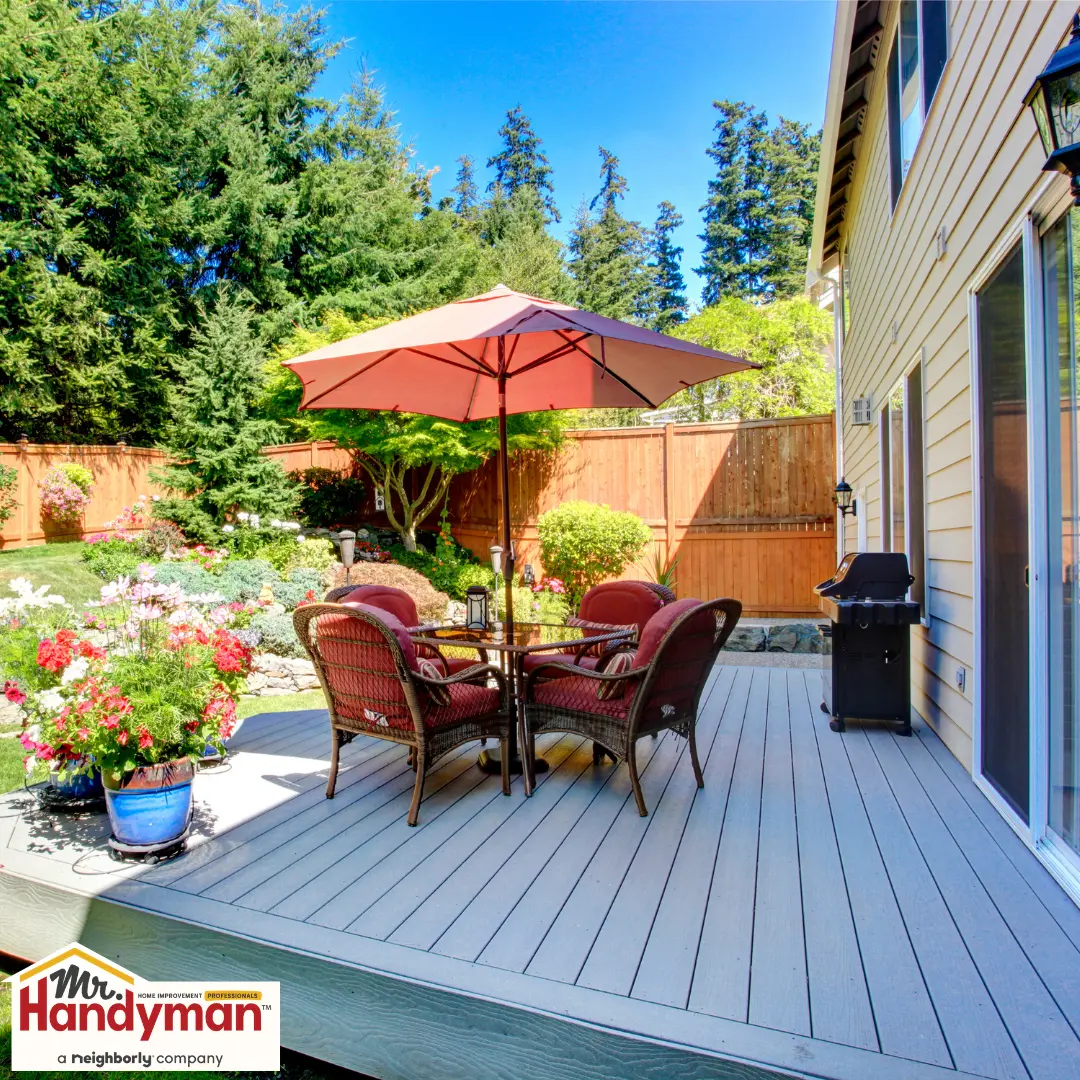
Outdoor furniture throughout Southwest Dallas County's residential communities emerges from winter storage or off-season exposure carrying the hardware and structural conditions that storage and North Texas seasonal exposure has produced. For Cedar Hill's lake-proximate properties where lake proximity elevated humidity creates corrosion conditions in furniture hardware more actively than inland Southwest Dallas County properties without equivalent lake proximity experience, furniture hardware assessment with specific corrosion awareness identifies replacement needs before summer's entertaining occasions place guest loads on furniture connections that corrosion may have compromised.
Frequently Asked Questions
Which deck and patio preparation tasks can Mr. Handyman of Southwest Dallas County perform under Texas law?
Mr. Handyman of Southwest Dallas County performs deck and patio preparation within the permitted handyman scope under Texas law including deck board repair and replacement with pre-treatment using mildewcide-containing products for Cedar Hill's lake-proximate properties, fastener correction, handrail and guardrail structural testing and reinforcement with corrosion-resistant hardware for Cedar Hill lake-proximate installations, stair repair, deck cleaning with biological growth removal products for lake-proximate properties, protective finish application with product selection appropriate for each Southwest Dallas County property's specific lake proximity and exposure conditions, concrete crack filling with flexible filler appropriate for Southwest Dallas County's clay soil movement, expansion joint sealant replacement, patio trip hazard surface grinding correction, natural stone and masonry hardscape joint assessment and repointing within the general maintenance scope for Cedar Hill's distinctive properties, and outdoor furniture hardware service.
How does Cedar Hill's Joe Pool Lake proximity specifically affect deck and patio preparation approaches?
Joe Pool Lake's proximity creates biological growth conditions on Cedar Hill's lake-adjacent outdoor wood surfaces that advance more rapidly than equivalent surfaces in inland Southwest Dallas County communities experience in the same regional climate. Protective finish products must include adequate mildewcide formulation addressing this specific biological growth challenge alongside the UV protection that North Texas's triple-digit summer intensity requires for all Southwest Dallas County outdoor structures. Hardware corrosion at structural connections advances more actively in Joe Pool Lake's lake proximity humidity than at inland Southwest Dallas County locations, making corrosion-resistant hardware specification for any structural connection replacement at Cedar Hill's lake-proximate properties more important than the equivalent replacement would make that specification at inland locations.
How does Southwest Dallas County's established community housing stock affect deck assessment priorities?
Southwest Dallas County's established communities of Duncanville, DeSoto, and Lancaster carry outdoor structure histories spanning multiple decades of North Texas seasonal cycling whose accumulated effects require assessment that accounts for that specific service history. Deck boards from earlier construction eras in these communities may carry the accumulated UV exposure and moisture cycling that multiple North Texas summer seasons have advanced beyond what newer construction's outdoor structures reflect at equivalent ages. Post base conditions from decades of clay soil moisture cycling may be more advanced in established community properties. And structural connection hardware from original or early replacement installations may not meet current corrosion-resistant specifications appropriate for continued service through additional North Texas seasonal cycles.
What protective finish is most appropriate for Cedar Hill's lake-proximate deck installations versus inland Southwest Dallas County properties?
Cedar Hill's lake-proximate deck installations warrant mildewcide-containing penetrating stains formulated for elevated humidity environments that provide biological growth resistance alongside the UV protection that North Texas's triple-digit summer requires. Inland Southwest Dallas County deck installations in Duncanville, DeSoto, Lancaster, Grand Prairie, and Mansfield warrant quality penetrating oil-based stains with adequate UV-inhibiting pigment and moisture resistance appropriate for North Texas's regional climate without the lake proximity biological growth amplification that Cedar Hill's specific conditions create. The key distinction is the mildewcide content and humidity performance specification that Cedar Hill's lake proximity makes more important than the standard UV and moisture protection emphasis appropriate for inland Southwest Dallas County installations.
How long does quality deck protective finish last across Southwest Dallas County's varied conditions?
Quality penetrating deck stains applied to properly prepared surfaces in Southwest Dallas County typically require reapplication every one to two years, with the specific timing within that range depending on each property's specific exposure conditions. Cedar Hill's lake-proximate installations may require reapplication toward the more frequent end of that range because the biological growth that lake proximity humidity supports on inadequately protected surfaces can deplete mildewcide protection within a single demanding summer season. Inland Southwest Dallas County installations may extend toward the less frequent end based on each specific installation's UV exposure, orientation, and canopy conditions. Monitoring water absorption rather than beading and biological growth appearance on the deck surface are the most reliable reapplication timing indicators regardless of elapsed time since previous application.
The Outdoor Space That Southwest Dallas County's Summer Deserves
Every deck and patio prepared deliberately before Southwest Dallas County's summer arrives performs as the genuine extension of the household life that North Texas's outdoor living culture makes most rewarding through the warm months. The structural confidence that handrail testing and fastener correction provides, the surface safety that board condition assessment and replacement delivers, and the protection that cleaning and protective finish application calibrated to each Southwest Dallas County property's specific conditions produces combine to create outdoor living spaces that summer's first gathering encounters at their best condition. In a service area whose diversity creates outdoor living contexts as varied as Cedar Hill's lakefront hillside terraces, Duncanville's and DeSoto's established backyard decks, and Mansfield's newer outdoor living installations, the preparation that honors each specific property's character and environmental context while protecting it through North Texas's most demanding season delivers the returns that thoughtful, Southwest Dallas County-specific preparation produces.
Mr. Handyman of Southwest Dallas County helps homeowners throughout the service area's varied communities prepare their decks and patios for summer within the permitted handyman scope under Texas law, from structural assessment and board replacement with product selection calibrated to each property's lake proximity or inland conditions through concrete and hardscape maintenance in Southwest Dallas County's clay soil environment.
Website: https://www.mrhandyman.com/southwest-dallas-county/
Serving Southwest Dallas County and the surrounding communities with dependable service and the expertise your home deserves.