|
Mr. Handyman® experts explain the correct stair handrail height and what homeowners need to know about height adjustment and code compliance:
|
Residential handrail height isn't just about passing inspection. Handrail standards are essential to keep everyone in your home steady and supported—from kids racing down for breakfast to aging parents visiting for the holidays to navigating stairs with an armful of laundry.
Homeowners considering mobility enhancements need to know what height a stair handrail should be. This guide breaks down everything you need to know about residential handrail height standards, from measuring your existing railing to recognizing when professional stair railing installation is required.
Article contents:
- The Standard Handrail Height for Residential Stairs
- How to Measure Your Stair Handrail Height Correctly
- Deck Handrail Height vs. Stair Handrail Height
- Other Important Handrail Requirements
- Special Considerations for Different Users
- Adjusting an Existing Handrail
- Choose Mr. Handyman for Professional Handrail Installation
- FAQs About Stair Railing Height
The Standard Handrail Height for Residential Stairs
The International Residential Code (IRC Section R311.7.8) requires handrails to be between 34 and 38 inches high, measured vertically from the stair tread nosing to the top of the handrail. This range is based on ergonomics research showing that 33 inches is the optimal handrail height, with a variation of ∓3 inches to help accommodate different adult heights.
Common Residential Handrail Heights
A handrail height of 36 inches is more or less universal in residential homes, since most adult hands naturally sit at this height when traversing the stairs, but there are situations when a higher or lower railing is a better option.
This quick reference chart provides an idea of where your handrail should land based on your household:
| Height | Best for | Notes |
|
34–35 inches |
Shorter households, homes with older children |
Lower end of code range |
| 36 inches | Most households (standard) | The “Goldilocks” zone (works for most people) |
| 37–38 inches | Taller households |
Upper end of code range |
Note: Handrail measurements are taken vertically from the stair tread nosing (the front edge of each step) to the top of the handrail.
Whatever height you choose within that 34 to 38 inch range must remain consistent throughout the entire stair run. Any variations over 1 inch can create awkward transitions and potential tripping hazards.
How to Measure Your Stair Handrail Height Correctly
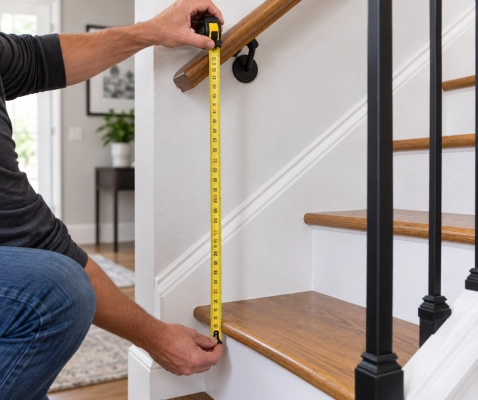
Measuring your stair railing may seem pretty straightforward, but plenty of homeowners make mistakes that throw off their readings. Even with the right tools, it's easy to get the handrail height wrong if you're measuring from the wrong spot or holding your tape measure at the wrong angle.
Steps for measuring handrail height
First, collect the tools you'll need to ensure an accurate measurement:
- Tape measure (25-foot recommended)
- Level (optional but helpful for alignment)
- Pencil for marking
- Notepad to record measurements at different points
Step 1: Locate the stair tread nosing. The nosing is the front edge of each step, where your foot lands when you're walking up or down. This is your measurement starting point—not the floor at the base of the stairs or the back of the tread.
Step 2: Measure vertically. Place your tape measure on the nosing and extend it straight up, perpendicular to the ground. Don't measure along the slope of the stairs—that creates a diagonal measurement that allows for inaccuracies. Read the measurement at the top of the handrail and write it down.
Step 3: Check multiple points. Measure at the bottom step, a middle step, and the top step. Your handrail height should be consistent (34–38 inches) at all three points. Variations of half an inch or less are normal, but anything over an inch means you've got a potential problem.
Common measurement mistakes to avoid
Even the most meticulous homeowners make these mistakes. To avoid any “missed steps,” here's what to watch out for:
- Measuring from the floor instead of the nosing: The floor doesn’t provide a relevant reference point for handrails. Always measure from the front edge of each tread, or your measurement will be off by several inches, and you'll wonder why your handrail feels wrong.
- Measuring along the slope: Holding your tape measure diagonally along the stair angle creates an inflated reading. Always measure straight up, perpendicular to the ground. Think of it like checking someone's height; you wouldn't measure them at an angle.
- Only checking one spot: Your handrail might vary along the run, especially if it was installed improperly or has shifted over time. Be sure to check the bottom, middle, and top to catch any inconsistencies before they become issues.
- Forgetting about flooring: Planning to install new carpet or flooring? Remember that it'll affect your handrail height measurement. Always measure from the finished floor surface.
Deck Handrail Height vs. Stair Handrail Height
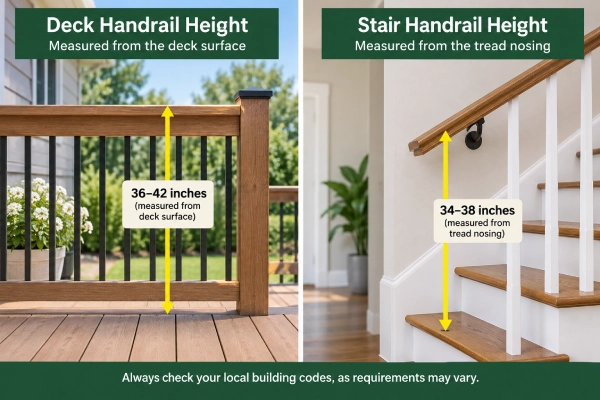
If you've got outdoor stairs, you may have noticed that the heights of your stair and deck handrails don’t quite line up. No, the contractor didn’t make a mistake—there’s a reason for the discrepancy. Essentially, guardrails keep you from falling off the side of the deck, while stair handrails help you stay balanced while moving up or down.
- Deck guardrails (the railings around your deck surface) have a 36-inch minimum height for residential decks and 42 inches for commercial decks. Their job is to prevent falls from elevated surfaces.
- Stair handrails (on your deck stairs going down to the yard) must be 34 to 38 inches from each stair tread (the same standard as indoor stairs). Their job is to provide support while you're navigating the steps.
If you're planning any deck construction or repairs, Mr. Handyman’s deck installation and repair services can make sure that both your deck guardrails and stair handrails are installed correctly.
Other Important Handrail Requirements
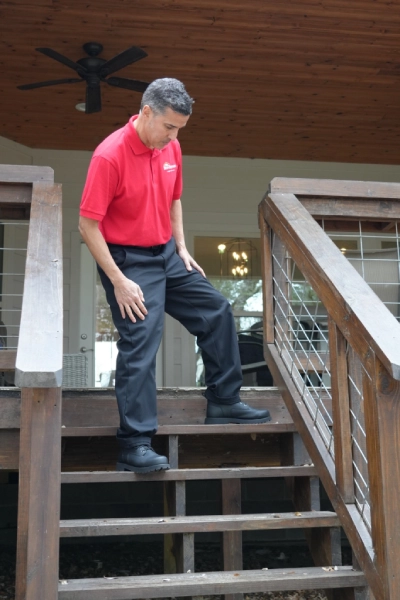
Height is just one piece of the puzzle. While you're checking your handrail height, here are other code requirements that can help ensure your handrail provides adequate support and stability:
- Clearance from wall: Leave a minimum of 1.5 inches between the handrail and wall for proper grip.
- Grip diameter: Circular handrails should be 1.25 to 2 inches in diameter; non-circular handrails need a 4 to 6.25-inch perimeter.
- Extensions: Rails should extend at least 12 inches beyond the top step and one tread depth beyond the bottom step.
- Continuity: Leave no gaps or breaks along the full stair run (except at newel posts).
- Mounting strength: Rails must withstand 200 lbs of force in any direction. Brackets must be anchored into wall studs, not just drywall.
These aren't minor details or "nice to haves." These requirements are what make a handrail supportive and code-compliant. For more home safety improvements, explore our carpentry services.
Special Considerations for Different Users
Households with children, seniors, or individuals with limited mobility may require specific adjustments to ensure handrails are well-suited to their needs.
Handrail height for children
Young children from ages 5–12 may find the standard adult handrail too high. While a properly positioned handrail (34–38 inches) is required by code, you can still add a secondary lower handrail. The kids’ rail should have a 28-inch maximum height, with at least 9 inches of clearance between the two rails. This gives children their own support system as they're learning stair independence.
Handrail height for seniors
Elderly family members need reliable handrail support for balance. If a handrail is too high or too low, it won't help when they need it most. The 35—36 inch range often works well for older adults; not too high to reach comfortably, not too low to require bending. For a complete guide to senior home safety beyond handrails, download our home safety checklist for seniors.
To learn more about aging-in-place modifications beyond handrail adjustments, explore Mr. Handyman's professional safety and mobility services.
ADA and accessibility considerations
While residential homes typically follow IRC standards rather than ADA accessibility requirements, accessibility features benefit everyone. Enhancing your handrails with textured ends, color contrast between the handrail and the wall, and stairway lighting can help.
Adjusting an Existing Handrail
Adjusting a handrail is possible when wall-mounted handrails are off by 1–2 inches and new stud locations are available at the correct height. The handrail is removed, old bracket holes are patched, and the rail is remounted at the proper height.
Full replacement may be needed if:
- The handrail is off from the acceptable range by four or more inches.
- The stairs have post-mounted systems that can't be easily adjusted.
- There are structural issues like loose mounting or stair railing damage.
Post-mounted handrails attached to newel posts require rebuilding the entire post structure to change the height; at that point, a full handrail replacement makes more sense and is more cost-effective than adjustment.
Many handrail height issues can be corrected without the need for a full replacement. Reach out to your local Mr. Handyman team for an in-house estimate.
Choose Mr. Handyman for Professional Handrail Installation
From quick height adjustments to full stair railing installations, your local Mr. Handyman team makes it easy to get the support you need without the stress. Our experienced and insured professionals measure carefully, anchor securely, and make sure your handrails feel right the moment you use them.
Every service is backed by the Neighborly Done Right Promise®—because we're not finished until you're happy with the result. Ready to stop second-guessing your next step? Explore our complete handrail and stair railing installation services, or find a Mr. Handyman location near you to request an in-home estimate. Let's get those handrails exactly where they should be!
This blog post may contain content, images, and/or multimedia generated with the assistance of artificial intelligence (AI). While every effort has been made to review, edit, and ensure accuracy, completeness, and alignment with our brand standards, we encourage readers to verify facts, consult trusted professionals, and use their own judgment when making decisions based on their situation.
This article is intended for general informational purposes only and may not be applicable to every situation. You are responsible for determining the proper course of action for your home and property. Mr. Handyman is not responsible for any damages that occur as a result of this blog content or your actions. For the most accurate guidance, contact your local Mr. Handyman location for a comprehensive, on-site assessment.
FAQs About Stair Railing Height
For over 25 years, Mr. Handyman professionals have been helping homeowners and businesses repair, maintain, and enhance their spaces. We are a one-stop solution for everything on your to-do list. This includes answering your questions about home repairs, maintenance, and improvements. Here are answers to some of your most frequently asked questions about stair railing height.
Can I install my handrail at 36 inches, or does it have to be exactly 34 or 38 inches?
You can install a stair handrail anywhere between 34 and 38 inches; it's a range, not a specific required height.
Most homeowners choose 36 inches as a comfortable middle ground that works well for people of different heights. The key requirement is maintaining consistent height throughout the entire stair run, measured from each stair tread nosing. As long as you stay within 34 to 38 inches, you're code-compliant
Request an appointment from Mr. Handyman for professional handrail installation at the perfect height for your household.
How do I know if I'm measuring stair handrail height from the correct starting point?
Always measure from the stair tread nosing (the front edge of each step where your foot lands). Place your tape measure on the nosing and extend it straight up vertically (perpendicular to the ground) to the top of the handrail. Don't measure from the floor, the back of the tread, or along the slope of the stairs; those create inaccurate readings. Check your measurement at the bottom, middle, and top steps to ensure consistent height throughout.
Need help? Schedule a handrail inspection or installation to ensure proper code-compliant measurements.
Do I need handrails on both sides of my residential stairs?
For residential stairs, the International Residential Code requires handrails on at least one side if you have four or more risers. However, stairs wider than 44 inches require handrails on both sides. Many homeowners choose to install rails on both sides even when only one is required, especially if elderly family members or young children use the stairs regularly.
Contact your local Mr. Handyman team for dual handrail installation to maximize safety and support throughout your home.
My handrail measures 39 inches high. Do I need to change it?
If your handrail is 39 inches, it's 1 inch above the IRC maximum of 38 inches, making it technically non-compliant. Whether you need to change it depends on your situation. If you're selling your home, an inspector will likely flag it, and buyers may request correction before closing. If the railing is for personal use only, you can decide whether to change it, but bringing it into compliance eliminates future issues with inspections or liability. Many stair railing height issues can be adjusted without full replacement.
Request an assessment from a Mr. Handyman professional to determine if adjustment or replacement is your best option.
Can my deck railing serve as a handrail for my deck stairs?
No, standard deck guardrails (typically 36–42 inches high) are usually too high to serve as proper handrails for stairs. Even on deck stairs, deck handrail height should be 34–38 inches measured vertically from each individual stair tread—not from the deck surface.
Deck guardrails prevent falls from elevated surfaces, while stair handrails provide support while navigating steps. They serve two different safety functions with different height requirements.
Schedule deck handrail service to ensure both your stair and deck handrail heights are up to code.
Do I need a permit to install or adjust a handrail?
Permit requirements vary by location. Many jurisdictions don't require permits for interior handrail adjustments in single-family homes, but some do—especially for new installations, exterior handrails, or multi-family properties. Commercial properties almost always require permits. Check with your local building department before starting any work.
Contact a Mr. Handyman team near you for handrail services that include permit assistance and code-compliant installation.