
Why Wichita Homeowners Are Looking Down Instead of Out
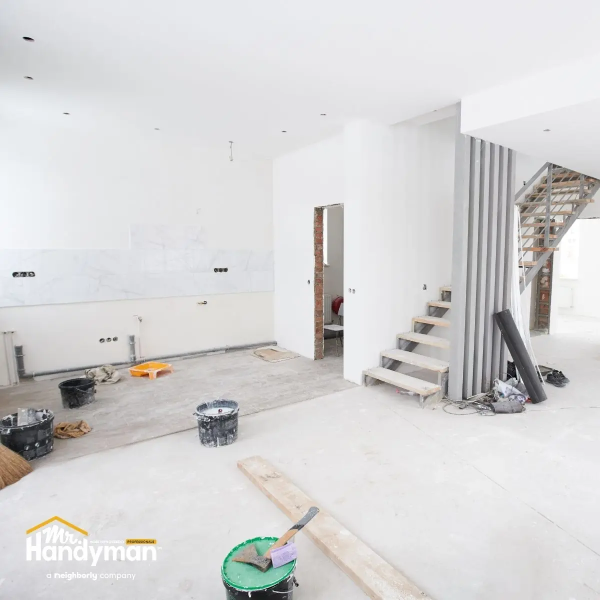
There is a particular moment in the life of a Wichita area household when the main floor stops being enough. It might happen when a second child arrives and the home office needs to become a bedroom. It might happen when an aging parent moves in and privacy becomes a priority for everyone. It might happen simply because the family has grown into every corner of the upper floors and there is nowhere left to expand without moving to a larger home in a market where larger homes carry a significantly larger price tag.
For most Wichita metro homeowners, the answer to that space problem is already under their feet. Basements are standard in the overwhelming majority of homes across the metro, from older properties in established neighborhoods like Linwood and Riverside to newer construction spreading through Andover, Derby, and Goddard. That is not an accident of preference. Kansas sits in Tornado Alley, and below-grade space has always served a dual purpose in this region, providing both storm shelter and additional square footage that the climate makes genuinely necessary. What separates a basement that is actively useful from one that is simply a place to store things and avoid is usually not a dramatic renovation. It is a series of targeted, well-considered improvements that address the specific conditions that make unfinished basement space uncomfortable and impractical.
This distinction matters because the conversation about basement improvement often defaults immediately to full finishing projects with drywall, dropped ceilings, recessed lighting, and dedicated rooms. Those projects have their place, but they are not the only path to meaningfully expanding your usable living space. Smaller, strategic improvements can transform a basement from dead storage into functional square footage that the entire household benefits from daily, often at a fraction of the cost and timeline of a full renovation.
Understanding What Your Wichita Basement Is Working Against
Before any improvement plan makes sense, it helps to understand the specific conditions that make basement spaces challenging in this part of Kansas. Wichita's climate creates a particular set of baseline problems that every basement improvement project needs to account for, regardless of scope.
Humidity is the dominant challenge. Kansas summers are humid, and that moisture has a persistent relationship with below-grade spaces. Soil surrounding a basement holds moisture from spring rains and summer storms, and that moisture works its way through concrete walls and floors through a process called vapor transmission. Even a basement that has never experienced a visible water intrusion event carries elevated humidity levels during warm months that make the space feel damp, promote mildew growth on stored items, and create conditions that are simply uncomfortable to spend time in.
Temperature fluctuation compounds the humidity issue. Wichita winters drive ground temperatures down significantly, and an uninsulated basement loses heat readily through its concrete walls and floor. In summer, the same uninsulated space can feel cool relative to the upper floors but becomes increasingly humid as warm outdoor air contacts the cooler concrete surfaces. Managing both humidity and temperature is the foundational work that makes everything else in a basement improvement project perform correctly.
The age of the home shapes which specific challenges present most urgently. Older homes in established Wichita neighborhoods frequently have basements with stone or brick foundation walls rather than poured concrete, which are more porous and more variable in how moisture moves through them. Homes built through the mid-twentieth century may also have basement floor drains that are no longer functioning correctly, sump pit installations that predate modern pump systems, and original small windows that provide minimal light and ventilation. Newer construction in suburban communities tends to have poured concrete walls in better condition, but even these are not immune to the vapor transmission and humidity dynamics that Kansas soil and climate produce.
Moisture Control Comes Before Everything Else
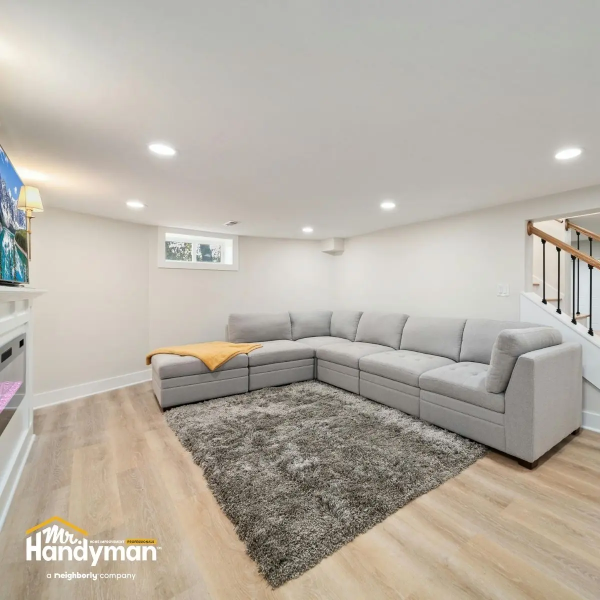
Every experienced contractor and every homeowner who has been through a basement improvement project more than once will tell you the same thing: moisture control is not a step in the process, it is the prerequisite for every other step. Improvements made in a basement that has not had its moisture situation addressed will degrade, warp, grow mold, and fail in ways that are both costly and discouraging.
Moisture control in a Wichita basement starts with an honest assessment of what you are actually dealing with. There is an important distinction between water intrusion, which is liquid water entering the space through cracks, gaps, or a failed drainage system, and vapor transmission, which is moisture moving through concrete in its gaseous state. Both require attention, but they require different interventions.
Water intrusion that produces visible wetness on walls after rain events points to issues with exterior grading, gutter drainage, or foundation crack sealing. Grading problems are common in older Wichita neighborhoods where soil has settled over decades and the ground immediately around the foundation no longer slopes away from the home as it should. Redirecting downspout extensions away from the foundation and correcting negative grade conditions around the perimeter of the home are the first interventions to make because they address the source of the water before it reaches the wall.
Vapor transmission is managed with the right barrier system applied to walls and floor before any finishing materials go in. A vapor barrier on the floor, either a sheet membrane under a floating floor system or an integrated barrier within a subfloor panel product, prevents ground moisture from wicking up through the concrete slab and into whatever flooring material sits above it. Wall insulation systems that include a drainage plane and vapor barrier function allow moisture to move to a collection point rather than becoming trapped behind finished surfaces where it promotes mold growth. Getting this right before a single piece of drywall or flooring goes in is what separates a basement improvement that lasts from one that requires remediation within a few years.
Lighting Changes That Transform How a Basement Feels
Nothing signals an unfinished, uninviting basement more immediately than poor lighting, and nothing transforms the feel of a below-grade space more efficiently than addressing it. Basements are working against natural light by definition. Windows are small, positioned high on the wall, and in many Wichita homes they face directions that provide minimal direct sunlight even when they are clean and unobstructed. Artificial lighting carries almost the entire burden of making a basement feel like a place people want to be rather than a place they pass through quickly.
The most common lighting mistake in basement improvement projects is treating the space as a single zone and installing a single overhead fixture or a row of bare bulbs on a switched circuit. This approach produces flat, harsh light that emphasizes the utilitarian character of the space rather than softening it. Layered lighting, combining ambient ceiling fixtures with task lighting over specific work areas and accent lighting that draws attention to the more finished elements of the space, produces a result that feels intentional and livable rather than improvised.
Recessed lighting is the most practical ambient solution for basement ceilings because it does not compete with headroom in spaces that are already working with limited ceiling height. LED recessed fixtures have made this approach significantly more accessible from a cost standpoint, and the ability to control color temperature allows homeowners to choose between warmer tones that feel residential and cooler tones that work better in workshop or utility-oriented spaces. Wichita basements being used as family rooms, playrooms, or home offices benefit from warmer color temperatures in the 2700 to 3000 Kelvin range, which read as inviting rather than institutional.
Flooring Options That Work With Basement Conditions
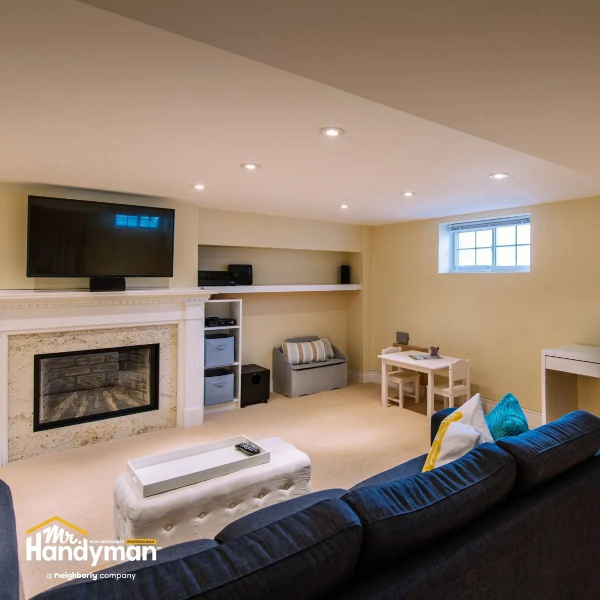
Flooring is where many basement improvement projects stall, not because the choices are limited but because the wrong choice made without accounting for basement-specific conditions leads to failure that is both frustrating and expensive to correct. The same flooring material that performs beautifully on the main floor of a Wichita home can buckle, warp, or grow mold in a below-grade environment if it is not suited to the moisture and temperature dynamics that basements produce.
Solid hardwood is the one material that should not go directly on a basement floor in this climate. Wood and concrete moisture vapor are a poor combination, and Kansas humidity swings make the problem worse by cycling the wood through repeated expansion and contraction. Engineered hardwood is more dimensionally stable and can work in a basement with a proper vapor barrier and controlled humidity levels, but it still requires careful evaluation of the specific space before installation.
Luxury vinyl plank is the practical standard for basement flooring in the Wichita metro market for good reason. It is fully waterproof, dimensionally stable, comfortable underfoot, and available in wood and stone looks that work with a wide range of design intentions. A quality luxury vinyl plank product installed over a vapor barrier and a thin foam underlayment addresses the moisture concern, adds a modest layer of thermal comfort over the concrete slab, and produces a floor that holds up to heavy use without the vulnerability of wood-based products.
Carpet is a reasonable choice in basement spaces that have been fully moisture-controlled and that will be used as dedicated living areas like family rooms or playrooms. The key qualifier is moisture control. Carpet installed in a basement that still has unresolved humidity or vapor transmission issues will develop odor and mold problems that make the space worse to be in than it was before the improvement. For families who want the warmth and comfort of carpet in a basement play or media area, area rugs over luxury vinyl plank offer a practical middle path that preserves the option to remove and replace the soft surface without affecting the underlying floor.
Defined Spaces That Make a Basement Feel Intentional
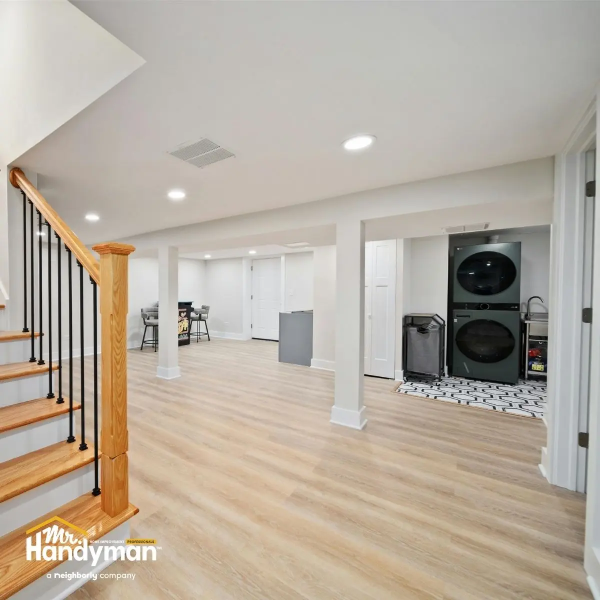
One of the most effective ways to elevate a partially finished or unfinished basement without committing to a full renovation is to create defined zones that give each area of the space a clear purpose. An open basement that functions as a catch-all for storage, exercise equipment, and the occasional overflow seating during gatherings feels chaotic regardless of how clean it is. The same square footage divided into purposeful zones feels organized, livable, and significantly larger than it actually is.
Zoning does not require walls. Area rugs, furniture arrangement, and lighting placement can define a family room zone, a homework or workspace zone, and a play area within a single open basement floor plan without any structural changes. Adding a freestanding bookshelf or a partial-height partition can reinforce the separation between zones while keeping the space open and flexible. In Wichita basements that serve as storm shelters, maintaining clear sightlines and unobstructed pathways between zones is also a practical safety consideration that open zoning supports naturally.
For basements where a dedicated room makes sense, whether a guest bedroom, a home office, or a hobby room, framing a non-load-bearing partition wall is a project that falls well within handyman scope and produces a meaningful functional result without the complexity of a full renovation. An egress window is required by code in any basement room intended to be used as a sleeping space, and that requirement exists for genuine safety reasons. Wichita area homeowners adding a basement bedroom should address egress window installation as a non-negotiable part of the project rather than an optional upgrade.
Storage Solutions That Free Up Space for Living
In most Wichita area basements, the single biggest obstacle to usable living space is not the square footage itself but the way existing storage has colonized it. Boxes stacked on the floor, seasonal items scattered without system, and utility areas that have expanded beyond their functional boundaries all consume space that could be serving the household in more active ways. Addressing storage organization before or alongside any improvement work produces immediate results and makes the finished space significantly more livable.
Built-in shelving along utility walls is one of the most efficient storage investments available in a basement context. Floor-to-ceiling shelving on a single wall can consolidate the contents of an entire basement floor into an organized, accessible system that takes up a fraction of the footprint that the same items occupied when stacked and scattered. Open shelving is practical for items that are accessed regularly. Closed cabinet storage works better for seasonal items, holiday decorations, and anything that benefits from dust protection.
Overhead storage systems that use the ceiling joist cavity in unfinished basement areas are another effective option for items that are rarely accessed. Sports equipment, camping gear, and seasonal decorations stored overhead free up floor and wall space for more active uses without requiring any additional square footage. In older Wichita homes with full-height basement ceilings, the overhead cavity between the joists represents meaningful storage volume that most homeowners leave completely unused.
Frequently Asked Questions
Do I need a permit for basement improvements in Wichita?
It depends on the scope of work. Cosmetic improvements like painting, flooring, and lighting fixture replacement generally do not require a permit. Framing new walls, adding electrical circuits, modifying plumbing, or installing an egress window typically do require permits and inspections. Checking with the City of Wichita's building services department before beginning any structural or mechanical work is always the right first step.
How do I know if my basement has a moisture problem before I start improving it?
A simple test involves taping a square of plastic sheeting to the concrete floor and wall, sealing all four edges with tape, and leaving it in place for 24 to 48 hours. If moisture collects on the underside of the plastic where it contacts the concrete, vapor transmission is present and needs to be addressed before flooring or wall finishes go in.
What is the most cost-effective basement improvement for adding usable space?
Lighting and moisture control together deliver the most meaningful improvement relative to their cost. A basement that is dry and well-lit is one that people actually want to spend time in, regardless of how finished the surfaces are. These two investments create the foundation that makes every subsequent improvement perform better.
Can I convert my basement into a bedroom for a family member?
Yes, with the appropriate code compliance steps. A basement bedroom requires an egress window that meets minimum size requirements for emergency exit, proper ceiling height, and adequate heating. Meeting those requirements makes the space both safe and legally habitable, which also affects how the square footage is treated in an appraisal.
How much does a partial basement improvement typically cost compared to a full finish?
Targeted improvements addressing moisture control, lighting, flooring, and basic organization typically run considerably less than a full basement finish, which involves framing, drywall, electrical, HVAC extension, and finish work throughout. The right scope depends on how the space will be used and what the household actually needs from it, not on a default assumption that more renovation is always better.
Let's Put Your Basement to Work
An underused basement is one of the most straightforward opportunities available to Wichita area homeowners who need more functional space without the cost and disruption of moving or adding on. Mr. Handyman of the Wichita Metro Area helps homeowners throughout the region tackle the targeted improvements that make below-grade space genuinely livable, from moisture barrier installation and lighting upgrades to framing, flooring, and storage solutions.
Call us or visit mrhandyman.com/wichita-metro-area to schedule service or talk through what your basement needs this spring. The space is already there. Making it work for your household is the next step.